Biography

Farid Aliniaeifard is a mathematician specializing in algebraic combinatorics, with a focus on developing algorithmic and pattern-recognition methods using representation theory.

Email: farid@sdu.edu.cn

Address: 

Office E422, Research Center for Mathematics and Interdisciplinary Sciences, 72 Binhai Road, Jimo District, Qingdao, Shandong Province, China Post Code:266237

Address in Chinese:  

山东省青岛市即墨滨海路72 山东大学华岗苑东楼E422


News: 


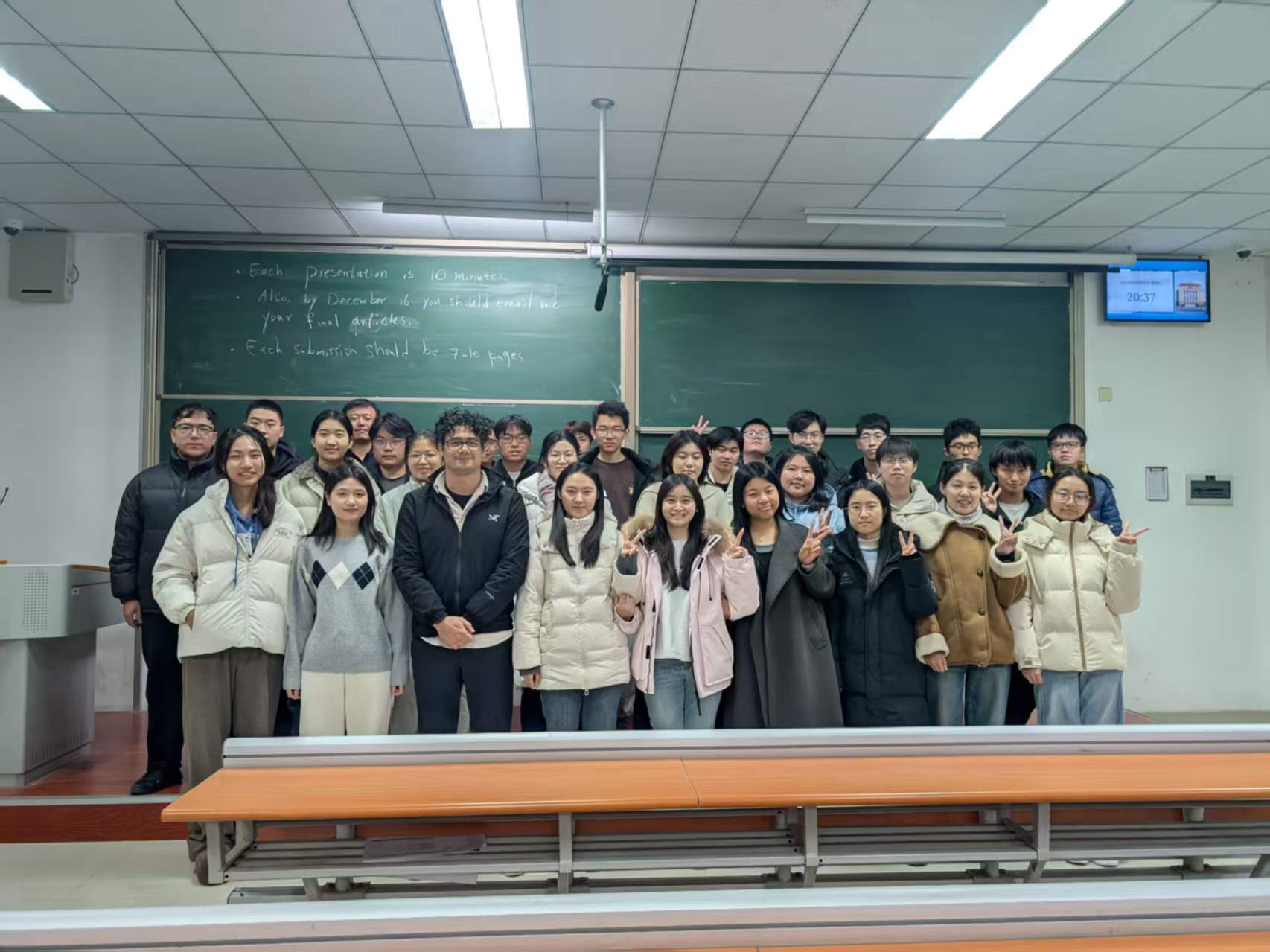
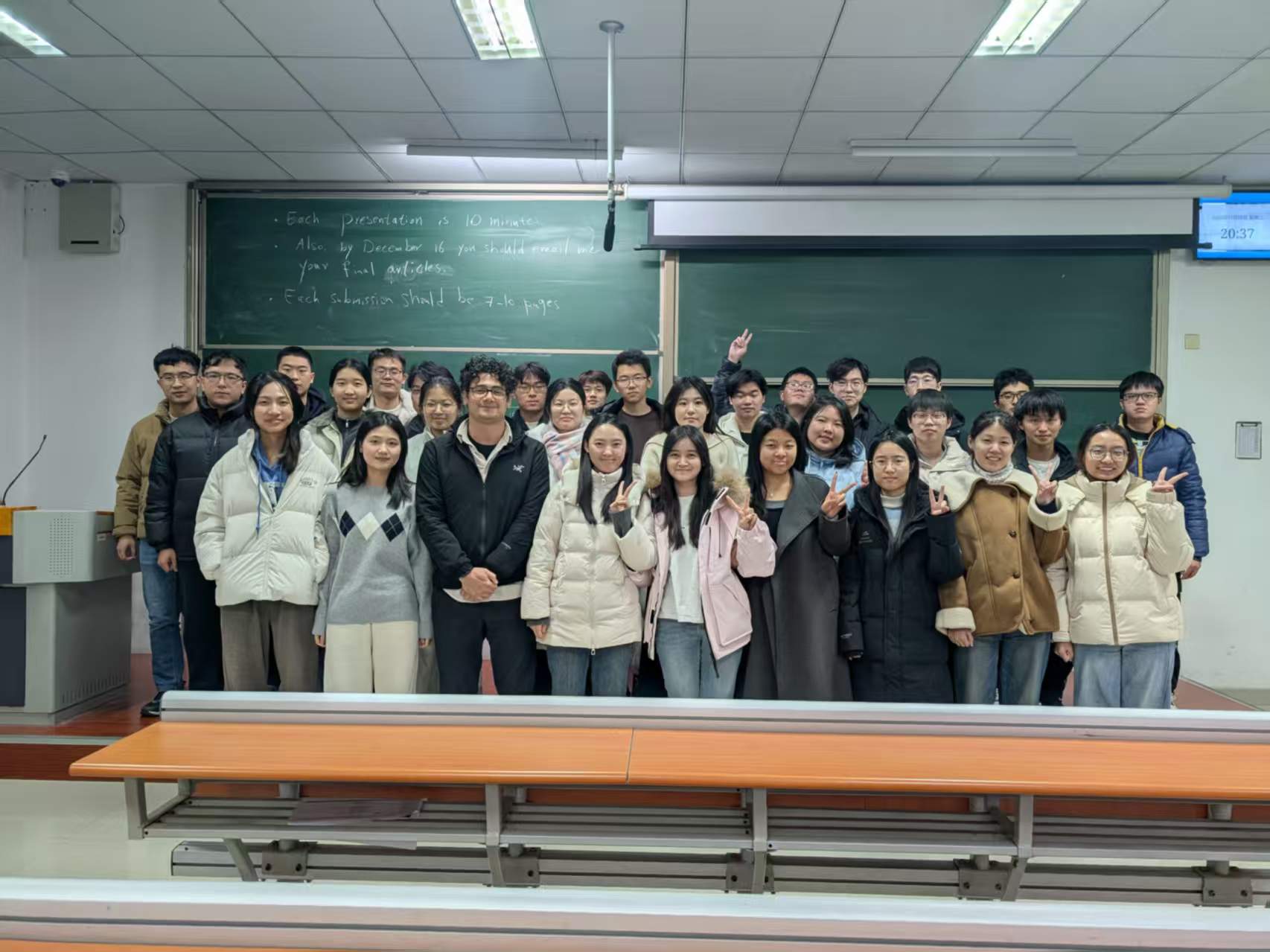
Last lecture of Thesis Writing and Academic Ethics(Picture with the students 1 - Picture with the students 2) (December 2025).


I present a virtual talk with the title Can AI Show Creativity in Mathematics - Or Is It Just a Tool? at Beijing Instituite of Technology School of Mathematics on December 12, 2025. (.pdf Slides) and (.ppt Slides)


I wrote the note Can AI Show Creativity in Mathematics? Discussing this question may be as profound as whether the machines can ever become conscious. You can find the note here https://github.com/AIMath-Lab/CreativeAI (December 2025). 


The paper, How to Use Deep Learning to Identify Sufficient Conditions: A Case Study on Stanley's e-Positivity, with Shu Xiao Li is now available at https://arxiv.org/abs/2511.20019 (November 26, 2025).


I wrote the note WHY, HOW, and WHAT of Writing a Research Paper in Mathematics presenting an approach to mathematical writing to help prevent that the main results from being overlooked by readers. You can find it here https://github.com/AIMath-Lab/MathematicalWriting (November 2025).


The paper, The extra basis in noncommuting variableswith Stephanie van Willigenburg, is the fourth Most Downloaded (in the past 90 days) paper in Advances in Applied Mathematics (August 2025).


The paper, The Peak Algebra in Noncommuting Variables, with Shu Xiao Li, is now available at https://arxiv.org/abs/2506.12868 (June 17, 2025)


I present a talk on how AI can help solving problems in combinatorics, especially combinatorial representation theory, at the Research Center for Mathematics and Interdisciplinary Sciences, Shandong University, June 19, 2025. 


The paper, Chromatic Quasisymmetric Functions of the Path Graph, with Shamil Asgarli, Maria Esipova, Ethan Shelburne, Stephanie van Willigenburg and Tamsen Whitehead McGinley was published in Annals of Combinatorics, May 26, 2025.


Education Background
  • York University
    Mathematics
    With Certificate of Graduation for Doctorate Study
Work Experience
  • 2025-05 — Now
    Research Center for Mathematics and Interdisciplinary SciencesProfessor of Mathematics, Shandong University
  • 2019-08 — 2024-08
    Postdoctoral Fellow, University of British Columbia
  • 2017-07 — 2019-08
    MathematicsVisiting Assistant Professor, University of Colorado Boulder
Working-Papers


How to Use Deep Learning to Identify Sufficient Conditions

A Case Study on Stanley's e-Positivity

Farid Aliniaeifard (farid@sdu.edu.cn) and Shu Xiao Li (lishuxiao@sdu.edu.cn)

Abstract. In a study, published in Nature, researchers from DeepMind and mathematicians demonstrated a general framework using machine learning to make conjectures in pure mathematics. Their work uses neural networks and attribution techniques to guide human intuition towards making provable conjectures. Here, we build upon this framework to develop a method for identifying sufficient conditions that imply a given mathematical statement. Our approach trains neural networks with a custom loss function that prioritizes high precision. Then uses attribution techniques and exploratory data analysis to make conjectures. As a demonstration, we apply this process to Stanley’s problem of e-positivity of graphs–a problem that has been at the center of algebraic combinatorics for the past three decades. Guided by AI, we rediscover that one sufficient condition for a graph to be e-positive is that it is co-triangle-free, and that the number of claws is the most important factor for e-positivity. Based on the most important factors in Saliency Map analysis of neural networks, we suggest that the classification of e-positive graphs is more related to continuous graph invariants rather than the discrete ones. Furthermore, using neural networks and exploratory data analysis, we show that the claw-free and claw-contractible-free graphs with 10 or 11 vertices are e-positive, resolving a conjecture by Dahlberg, Foley, and van Willigenburg.


Publication
Papers

(1) Farid Aliniaeifard, Shamil Asgarli, Maria Esipova, Ethan Shelburne, Stephanie van Willigenburg and Tamsen Whitehead McGinley, Chromatic Quasisymmetric Functions of the Path Graph, Annals of Combinatorics, 2025

(2) F. Aliniaeifard and S. van Willigenburg, The extra basis in noncommuting variables, Adv. in Appl. Math. 168 (2025) [20 pages]

(3) F. Aliniaeifard and S. Li, Peak algebra in noncommuting variables, The 37th Conference on Formal Power Series and Algebraic Combinatorics (FPSAC), Sapporo, Japan, 2025.

(4) F. Aliniaeifard, V. Wang, and S. van Willigenburg, The chromatic symmetric function of a graph centred at a vertex, Electron. J. Combin. 31, (2024) [34 pages].

(5) F. Aliniaeifard, V. Wang, and S. van Willigenburg, Deletion-contraction for a unified Laplacian and applications, Linear Algebra Appl. 691 (2024) 50–95.

(6) F. Aliniaeifard and Nat Thiem, Stanley chromatic functions and a conjecture in the representation theory of unipotent groups, Proceedings of the 36th Conference on Formal Power Series and Algebraic Combinatorics (FPSAC), Bochum 2024.

(7) F. Aliniaeifard, S. Li, and S. van Willigenburg, Generalized chromatic functions, Int. Math. Res. Not, IMRN, (2024) [45 pages].

(8) F. Aliniaeifard, V. Wang, and S. van Willigenburg, P-partition power sums, European J. Combin. 110, 103688 (2023) [16 pages].

(9) F. Aliniaeifard and Nathaniel Thiem, Hopf structures in the representation theory of direct products, Electron. J. Comb. 29, (2022) [33 pages].

(10) F. Aliniaeifard, S. Li, and S. van Willigenburg, Schur functions in noncommuting variables, Adv. Math. 406, 108536 (2022) [37 pages].

(11) F. Aliniaeifard and N. Thiem, A categorification of the Malvenuto–Reutenauer algebra via a tower of groups, Adv. Math. 383, 107675 (2021) [43 pages].

(12) F. Aliniaeifard, V. Wang, and S. van Willigenburg, Extended chromatic symmetric functions and equality of ribbon Schur functions, Adv. in Appl. Math. 128, 102189 (2021) [29 pages].

(13) F. Aliniaeifard and N. Thiem, Pattern groups and a poset based Hopf monoid, J. Combin. Theory Ser. A 172, 105187 (2020) [31 pages].

(14) F. Aliniaeifard and N. Thiem, Pattern groups and a poset based Hopf monoid, Proceedings of the 31st Conference on Formal Power Series and Algebraic Combinatorics (FPSAC), Ljubljana 2019. This is the short version of the paper “Pattern groups and a poset based Hopf monoid" published at J. Combin. Theory Ser. A.

(15) . Aliniaeifard and N. Thiem, The structure of normal lattice supercharacter theories, Algebr. Comb. 3 (2020) 1059– 1078.

(16) F. Aliniaeifard, Normal supercharacter theories, Ph.D. thesis, York University, 2017.

(17) F. Aliniaeifard, Normal supercharacter theories and their supercharacters, J. Algebra 469 (2017) 464-484.

(18) F.Aliniaeifard, Normal supercharacter theory, Proceedings of the 28th Conference on Formal Power Series and Algebraic Combinatorics (FPSAC), Vancouver 2016.

(19) F. Aliniaeifard, Y. Li, and W. Nicholson, Morphic p-groups, J. Pure Appl. Algebra 217 (2013) 1864-1869.

(20) F. Aliniaeifard and M. Behboodi, Rings whose annihilating-ideal graphs have positive genus, J. Algebra Appl. 11, 1250049 (2012) [13 pages].

(21) F. Aliniaeifard and M. Behboodi, Commutative rings whose zero-divisor graphs have positive genus, Comm. Algebra 41 (2013) 3629-3634.

(22) F. Aliniaeifard, Zero divisor graph of a group ring, Master’s thesis, Brock University, 2013.

(23) F. Aliniaeifard, M. Behboodi, E. Mehdi-Nezhad, and A. Masoud Rahimi, The annihilating-ideal graph of a commutative ring with respect to an ideal, Comm. Algebra 42 (2014) 2269-2284.

(24) F. Aliniaeifard and Y. Li, Zero-divisor graphs for group rings, Comm. Algebra 42 (2014) 4790-4800.

(25) F. Aliniaeifard, M. Behboodi, and Y. Li, The annihilating-ideal graph of a ring, J. Korean Math. Soc. 52 (2015) 1323- 1336.

Student Information
  • Victor Wang  2025-05-20 Hits:[] Times
  • Copyright All Rights Reserved Shandong University Address: No. 27 Shanda South Road, Jinan City, Shandong Province, China: 250100
    Information desk: (86) - 0531-88395114
    On Duty Telephone: (86) - 0531-88364731 Construction and Maintenance: Information Work Office of Shandong University