Hydrogen absorption heat mass transfer characteristics in a rotating metal hydride reactor
Hits:
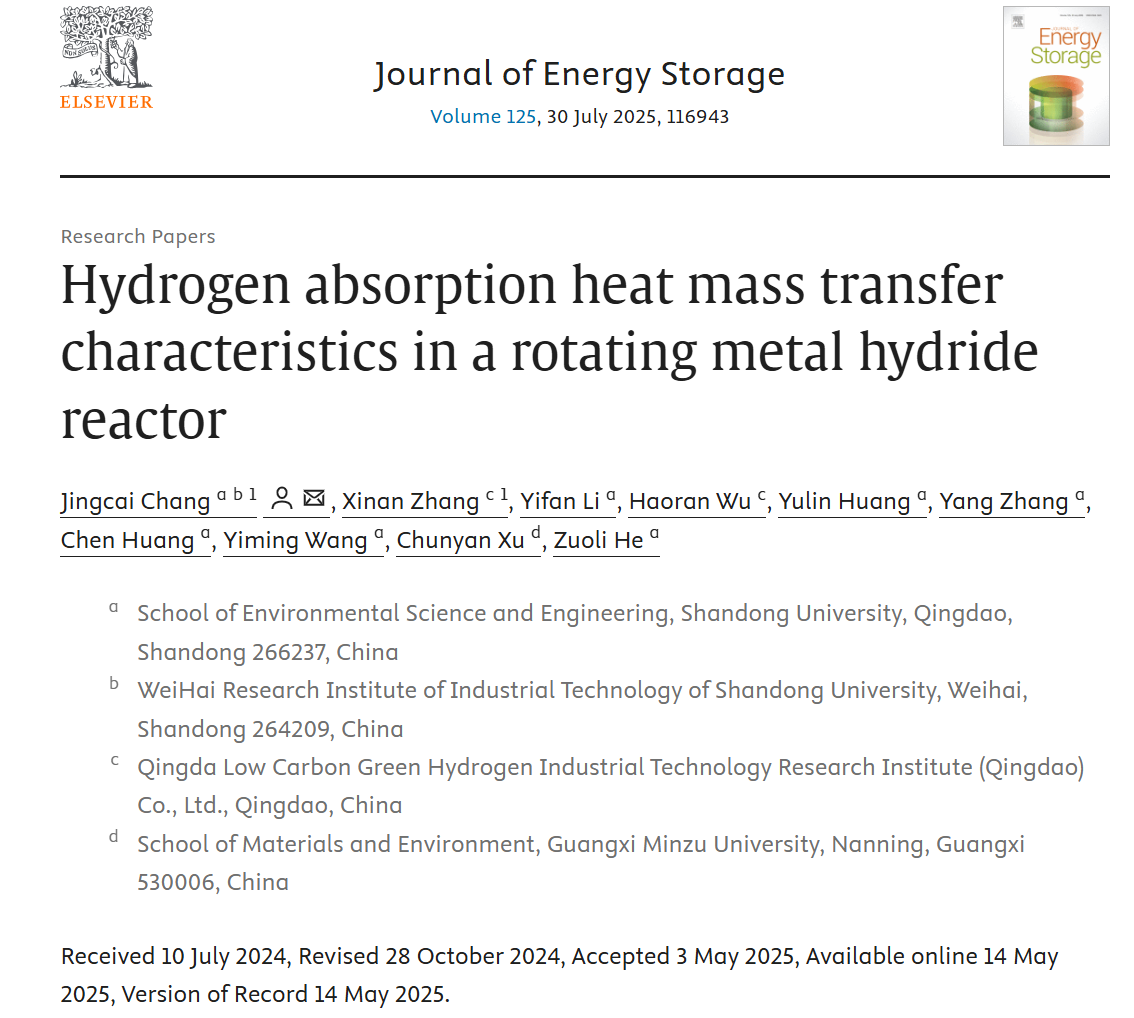
Title of Paper:Hydrogen absorption heat mass transfer characteristics in a rotating metal hydride reactor
Journal:Journal of Energy Storage
Place of Publication:Elsevier
Key Words:Metal hydride reactor; Rotating; Heat mass transfer; Alloys rearrangement
Summary:Proper design of a metal hydride reactor is essential to guarantee the stable high-level reversible hydrogen storage. Multifarious factors, including reactor structure, operating conditions, thermal management measures, and stress relief methods, have been subjected to intensive study. However, less attention was devoted to the effects of motion state for alloy particles on hydrogen absorption heat mass transfer. This paper focuses on the pulverization alloy motion and rearrangement created by a new type of rotating reactor to explain the enhanced heat and mass transfer properties, using real-time dynamic comparative recordings at different rotating speeds. The conclusions indicated that the dynamic rotating reactor showed a higher heat dissipation rate, resulting in lower temperature changes. The hydrogen absorption rate of the rotating reactor was enhanced by 34 % due to the difference in the control weights of the reaction stages and the rate-controlling step. Furthermore, the rotating reactor demonstrated an average hydrogen absorption capacity that was 3.6 % greater than that of a vertical reactor. These advancements owe much to better rearrangement of pulverization alloys caused by a denser frequency and intensity of particle motion and collisions. Under a certain appropriate dynamic range, this new type of rotating reactor can effectively relieve local particle accumulation, further reduce mass transfer resistance, and prominently prevent deactivation in the hydrogen absorption capacity of alloys.
Correspondence Author:Jingcai Chang
All the Authors:Xinan Zhang,Yifan Li,Haoran Wu,Yulin Huang,Yang Zhang,Chen Huang,Yiming Wang,Chunyan Xu,Zuoli He
Document Code:116943
Discipline:Engineering
First-Level Discipline:Resources and Environment
Document Type:J
Volume:125
Page Number:116943
DOI Number:10.1016/j.est.2025.116943
Number of Words:6000
Translation or Not:No
Date of Publication:2025-07
Included Journals:SCI
Links to Published Journals:https://doi.org/10.1016/j.est.2025.116943
Release Time:2026-08-03